
Federated APIOps with Kong · Part 2. Part 1 is the design. This part builds it. The code is in kong-federated-apiops.
Three GitHub Actions workflows run the design: a platform workflow (Terraform), a reusable team pipeline (decK, lint, oasdiff) and a drift workflow. You’ll run them against two Kong Gateway Enterprise environments in Docker, then try the changes a team must not be able to make.
At a glance
- You get: two teams deployed to dev and prod from OpenAPI,
403for edits outside a team’s workspace or to a mandatory plugin, and a drift workflow that fails on overrides and hand edits. - You need: Docker, mise, and a Kong Gateway Enterprise license file. Kong sends it “when you sign up for a Kong Gateway Enterprise subscription”.
- Settings to get right: bootstrap before
enforce_rbac = both,--workspaceon every decK call.
How it works
The team pipeline is the part teams touch; the platform and drift workflows appear in steps 2 and 5.
Step 1: Start and bootstrap
Versions used: Kong Gateway Enterprise 3.16.0.3 · decK 1.70.1 · Terraform 1.17.2, kong/kong-gateway provider 1.4.1 · oasdiff 1.38.0 · act 0.2.98
Put the license in ~/.kong-license-data/license.json (or set KONG_LICENSE_FILE), then:
git clone https://github.com/bhatikuldeep/kong-federated-apiops.git
cd kong-federated-apiops
mise install
make up
make up takes about two minutes. It starts dev and prod with enforce_rbac = on, runs the one-time bootstrap workflow for each (one Admin API call per step), switches Kong to both, then runs the platform and team workflows locally with act:
✅  Success - Main The super admin sees every entity
✅  Success - Main User ci-platform
✅  Success - Main   has the built-in role super-admin
The platform pipeline runs as ci-platform with Kong’s built-in super-admin role, “Full access to all endpoints, across all Workspaces, including the ability to assign and modify RBAC permissions”. Under entity-level RBAC it also needs an entity permission; entity_id "* matches any entity ID".
The first time, I ran act with --bind to keep Terraform state between runs. A checkout step wiped my working copy. The lab now refuses --bind and keeps state in Postgres.
Step 2: Lock the mandatory plugins (Terraform)
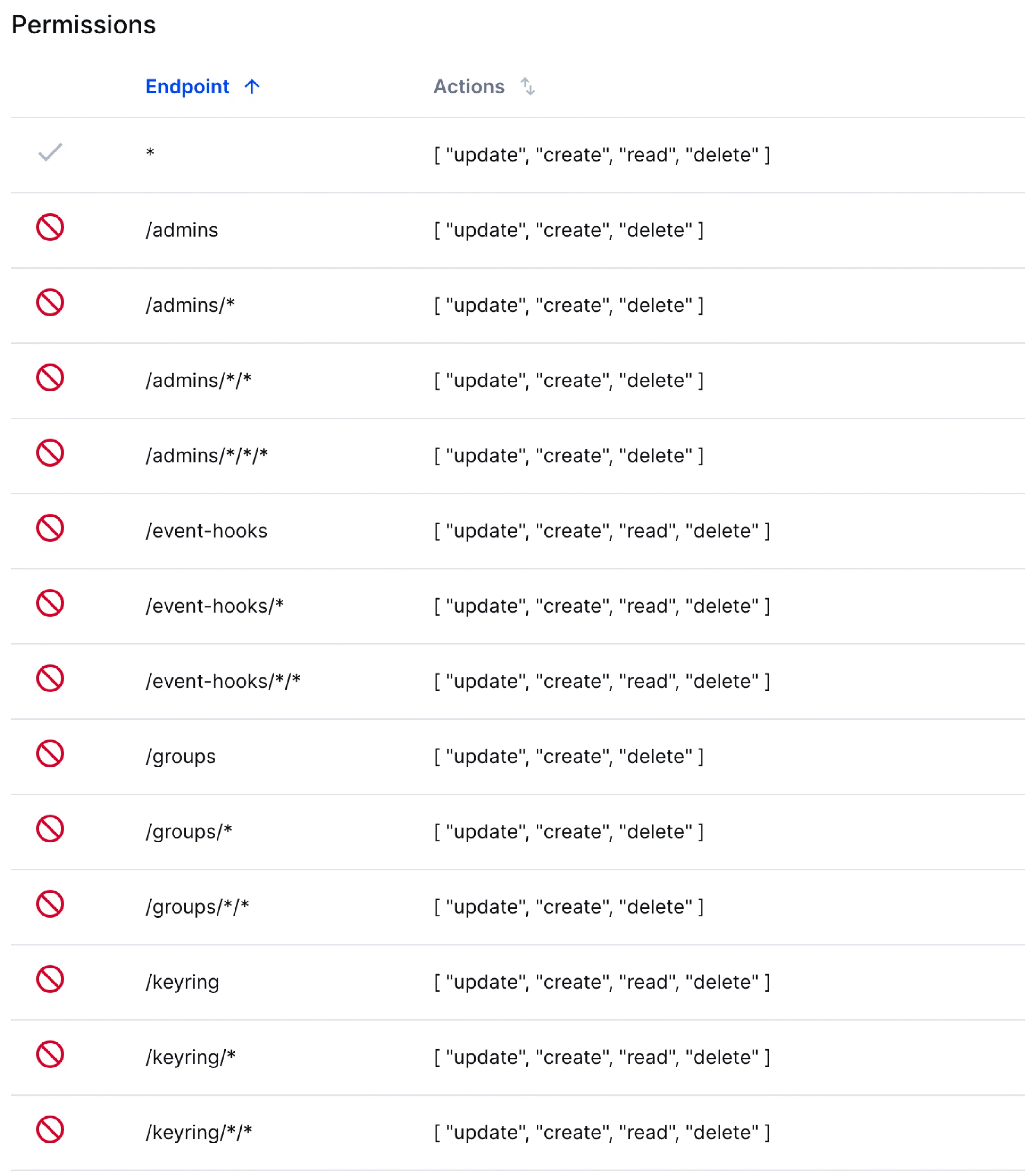
The platform workflow creates each team’s workspace, two roles, pipeline RBAC user and mandatory plugins. The pipeline gets a custom apiops-deployer role; people get workspace-read-only, named after Kong’s workspace role with “Read access to all endpoints in the Workspace”. Two entity permissions give the team its workspace and lock the mandatory plugins:
# platform/foundation/rbac.tf (excerpt)
resource "kong-gateway_rbac_role_entity" "deployer_all" {
  entity_id   = "*"          # every entity
  entity_type = "wildcard"
  actions     = ["read", "create", "update", "delete"]
}

resource "kong-gateway_rbac_role_entity" "deployer_protect" {
  for_each    = local.mandatory_plugin_ids
  entity_id   = each.value.id   # one mandatory plugin
  entity_type = "plugins"
  actions     = ["update", "delete"]
  negative    = true            # denied, despite the wildcard
}
Step 3: Ship a team’s API from OpenAPI
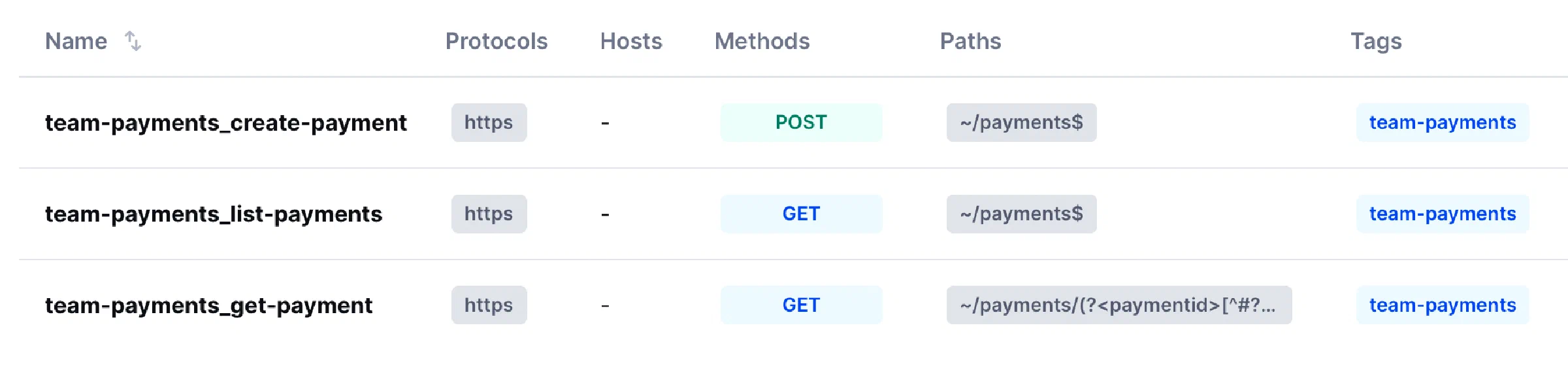
A team folder holds openapi.yaml, plugins.yaml, consumers.yaml and, optionally, rules/ and environments/. The build action runs five decK commands in it, with TAG=team-<team>:
cd teams/payments && TAG=team-payments
deck file openapi2kong -s openapi.yaml \
  --select-tag "$TAG" --uuid-base "$TAG" -o 1-oas.yaml
deck file add-plugins -s 1-oas.yaml -o 2-plugins.yaml plugins.yaml
deck file merge -o 3-merged.yaml 2-plugins.yaml consumers.yaml
deck file add-tags -s 3-merged.yaml -o 4-tagged.yaml "$TAG"
deck file patch -s 4-tagged.yaml -o kong.yaml --selector '$' \
  --value "_info:{\"select_tags\":[\"$TAG\"]}" \
  --value '_workspace:"payments"'
Each ruleset then runs as its own deck file lint step. On pull requests, oasdiff compares the spec with the base branch. Try it on the repository’s example of a removed operation:
oasdiff breaking teams/payments/openapi.yaml \
  tests/fixtures/breaking/openapi.yaml --fail-on MISSING-VERSION-BUMP
1 changes: 1 error, 0 warning, 0 info
error	[api-path-removed-without-deprecation] at teams/payments/openapi.yaml
	in API GET /payments/{paymentId}
		API path removed without deprecation

versioning policy: violated. info.version moved from 1.2.0 to 1.3.0 without a major version increase.
Job 2 then pings the environment, applies environments/<env>.yaml if there is one, dumps the team’s config as a rollback point and syncs with the team’s token. Pass --workspace on every call. Without it, decK used the default workspace and stopped with HTTP status 403.
deck gateway sync --workspace payments kong.yaml
Summary:
  Created: 8
  Updated: 0
  Deleted: 0
Step 4: Try what a team must not do
make test
make test runs a rogue team’s files through the rulesets, then tries each forbidden change with the payments pipeline token. The rogue spec, then the decK file built from it:
[error][3:7] info.contact is required (who owns this API?)
[error][17:7] operationId is required
[error][2:1] a top-level security requirement is required

[error][10:9] plugin is not on the platform's allowed list
[error][22:11] plugin is not on the platform's allowed list
[error][1:1] top-level (global) plugins are reserved for the platform team
[error][26:5] the ordering field is reserved for the platform team
| Who tries what | Result |
|---|---|
A payments developer with workspace-read-only: read payments | 200; any change or orders 403 |
Payments token: read or write in orders | 403 |
| Payments token: create an RBAC user, role or workspace | 403 |
| Payments token: switch off or delete a mandatory plugin | 403 |
Payments token: add its own rate-limiting to its service | 201, and it replaces the platform’s limit: drift catches it (step 5) |
| Payments token: update its own plugin | 200 |
| Platform token: update the mandatory plugin | 200 |
Step 5: Drift and repair
| Changed outside the pipelines | Caught by | Repaired by |
|---|---|---|
| A service edited by hand | deck gateway diff --non-zero-exit-code | the team pipeline |
A plugin added by hand, even one tagged platform | lint of a workspace dump with the team’s rules | deleting it |
| A mandatory plugin switched off or deleted | terraform plan -detailed-exitcode | the platform workflow |
To see one, edit the payments service with its token, then run the drift workflow:
curl -s -X PATCH http://127.0.0.1:18001/payments/services/team-payments \
  -H "Kong-Admin-Token: $(lab/lab.sh token dev payments)" \
  -H 'Content-Type: application/json' -d '{"retries":9}'
lab/lab.sh act drift.yaml
Only the payments job in dev fails (act’s output):
updating service team-payments  {
-  "retries": 9,
+  "retries": 5,
❌  Failure - Main Drift: managed config differs from the repository
Use it for your own gateways
- Add a team: an entry in
teams.yaml,platform/governance/teams/<team>.yaml, and its secrets in the GitHub environments, fromterraform output ci_tokens(the checklist). For a read-only Kong Manager, have your identity provider send<team>:workspace-read-only, Kong’sWORKSPACE_NAME:ROLE_NAMEclaim format. Part 3 shows it with Keycloak. - Bootstrap each environment once with
enforce_rbac = on, then switch toboth. - Keep Terraform state in a locked remote backend; it holds every team’s token.
- Keep Kong tokens in GitHub environments, not repository secrets: “Secrets stored in an environment are only available to workflow jobs that reference the environment”. Pull requests plan against
devonly;prodtakesmainonly, with reviewers (all settings). - Use runners that can reach the Admin API, and put TLS on it.
- Rotate a team token with
terraform apply -replace='random_password.ci_token["<team>"]', then redeploy once. - Roll back a deploy with
deck gateway sync --workspace <team> --select-tag team-<team> --skip-consumers <backup>.yaml.
With one repository per team (how to split one out), the team owns its workflow file and could stop calling the central rulesets. Keep its prod token behind a prod environment with the platform team as reviewers. This setup doesn’t cover hybrid mode, Kong upgrades or Konnect.
Next: Part 3 lets people sign in to Kong Manager with Keycloak, their group deciding which workspace they can read.
Troubleshooting
| You see | Fix |
|---|---|
Empty lists or 403 for the super admin after switching to both | Bootstrap with enforce_rbac = on first. |
403 from deck gateway | Pass --workspace. |
403 on PATCH of a plugin or consumer by ID | Use PUT, as decK does. |
426 Please use HTTPS protocol | Routes default to HTTPS since 3.14, so serve TLS. |
deck gateway validate: config.namespace: required field missing | Set a namespace on rate-limiting-advanced. |
Clean up
make clean